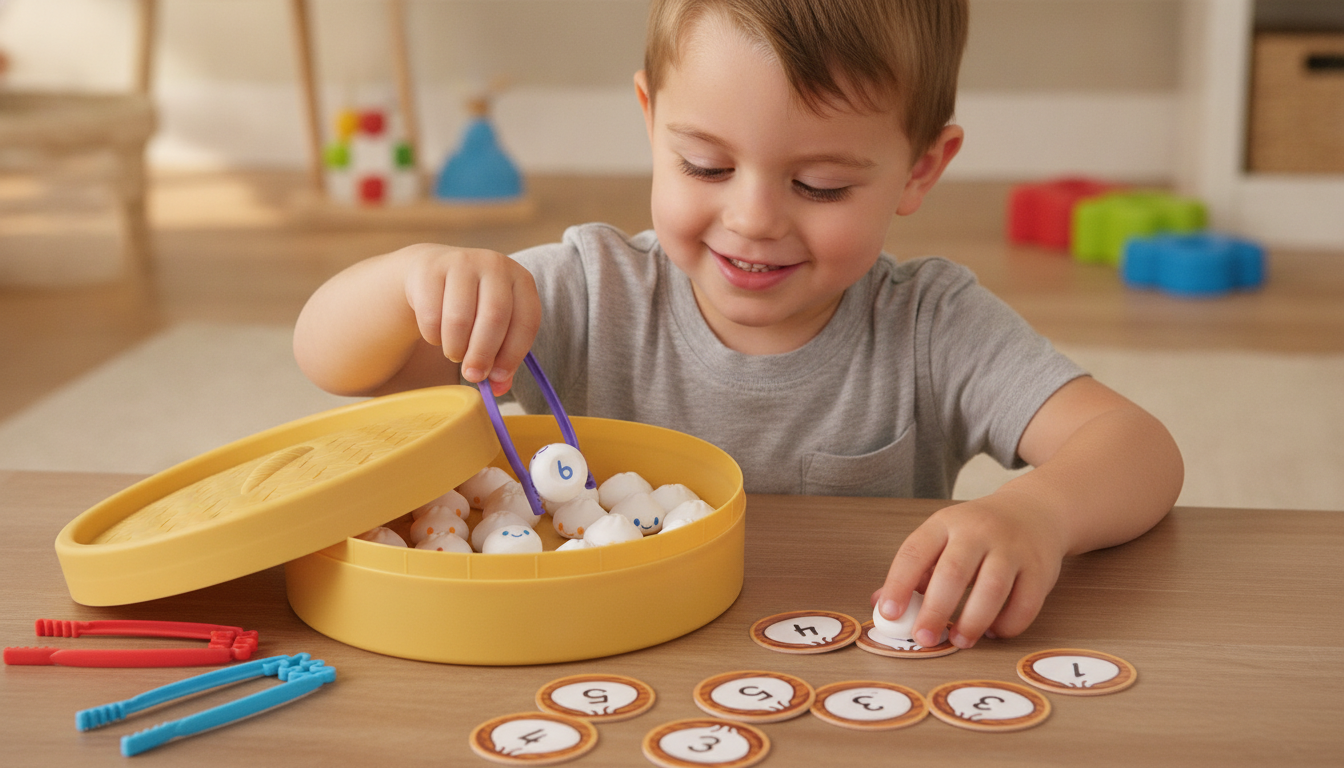
Players draw number cards and use chopstick tongs to grab two dumplings that add or subtract to the number shown. The steamer basket serves as game board and storage, with surprise dumplings altering gameplay. Amazon
Who this toy suits

The Learning Resources Dumpling Dash Fine Motor Math Game is recommended for children ages 5 and up. It is designed for young learners in early elementary grades who are beginning to explore addition and subtraction. The game is a good fit for children who enjoy hands-on, interactive play with a food theme and those interested in activities that involve using tools like chopstick-style tongs. Because the game includes small dumpling pieces and tongs, it is not suitable for children under 5 years old due to choking hazards.
What children can do and learn

- Use chopstick-style tongs to pick up and move small dumpling pieces, providing opportunities to practice gripping, squeezing, and hand-eye coordination. Research suggests that play materials such as tongs and tweezers can help children exercise the small muscles in their hands and fingers, supporting the development of fine motor skills (Preschoolers at Play, p. 104–107). This is general guidance about fine motor play, not evidence specific to this toy.
- Practice basic addition and subtraction by drawing number cards and selecting two dumplings whose values add up to or subtract to the target number. This hands-on approach allows children to manipulate objects while engaging with number concepts, which aligns with early math learning strategies that encourage counting and computing with manipulatives (NAEYC - Helping Your Child See and Show Mathematical Ideas). This is general math play guidance, not a study of this product.
- Take turns drawing cards and collecting dumplings, providing opportunities for sharing and cooperative play. General research highlights that playing games with peers and adults can help children practice social skills such as taking turns and working together (HealthyChildren.org - The Power of Play). This is general play guidance, not specific to this toy.
Play ideas to try

- Number Match Challenge: Draw a number card and use the tongs to pick two dumplings that add up to or subtract to the number shown. Take turns with another player to see who can find a match first.
- Surprise Dumpling Actions: When a surprise dumpling is drawn, follow the action on the card, such as losing a turn or choosing a new number. This adds variety to each round.
- Pretend Restaurant: Use the steamer basket as a serving tray and create pretend meals with the dumplings. Count out orders or subtract dumplings as meals are "served," blending math practice with imaginative play.
(These are optional parent suggestions and not official game modes.)
Before you buy

The Dumpling Dash Fine Motor Math Game contains small dumpling pieces and chopstick tongs, so it is important to keep track of all components during and after play. The game is not appropriate for children under 5 years old due to choking hazards. It is designed for two players and does not require batteries or electronic parts. The steamer basket serves as both the game board and storage container, making setup and cleanup straightforward. This toy is best suited for children interested in hands-on math games and fine motor activities with a playful food theme.
When another type may fit
If your child finds it challenging to handle small pieces or prefers simpler manipulation, consider math games with larger pieces or card-only formats. For children who are more interested in pretend play without math tasks, a play food kitchen set may be a better fit.
Sources
- Learning Resources Dumpling Dash Fine Motor Math Game - Amazon
- Preschoolers at Play, NAEYC (PDF)
- Helping Your Child See and Show Mathematical Ideas | NAEYC
- The Power of Play: How Fun and Games Help Children Thrive | HealthyChildren.org
Research sources above provide general play guidance and are not evidence of outcomes for this specific toy.